
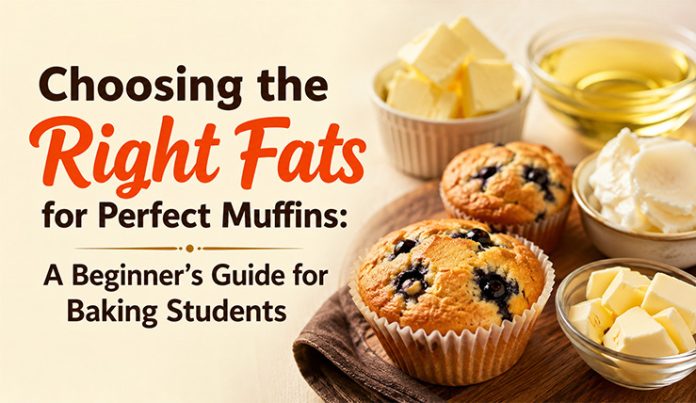

There’s a specific kind of quiet that settles over a kitchen right after a tray of muffins comes out looking off. Not burnt. Not raw. Just off dense in a way they shouldn’t be, oily around the edges, sunk in the middle like the whole thing lost confidence halfway through baking. Most beginners assume they mismeasured something or blame the oven. Rarely does anyone suspect the fat. Yet fat is arguably the single ingredient that decides whether a muffin turns out effortless or forced. Anyone looking into Professional Bakery Courses In Chennai will run into this idea fairly early, fat selection isn’t treated as a minor detail in serious training, it’s treated as something worth actually understanding.
This piece is meant to walk through that decision without overwhelming anyone. Butter, oil, and a handful of less-talked-about options in between all behave differently once heat gets involved, and that behavior is learnable, not some kind of guarded secret. By the end, the hope isn’t to leave readers with a rigid checklist but with enough of a feel for the subject that adjusting a recipe becomes second nature, the way it eventually does for anyone who’s spent real time in a kitchen. Along the way, this covers why fat matters in the first place, how butter and oil pull in different directions, where the in-between fats fit into that picture, how much fat a batter genuinely needs, where beginners tend to trip up, and how all of it connects back to building real instinct rather than just following steps.
Why Fat Carries So Much Weight in a Muffin
It’s easy to assume fat is mostly there for flavor. In muffins, though, it’s doing structural work. It coats the flour, holds gluten development in check, and that’s the whole reason a muffin stays tender instead of turning chewy like a loaf of bread. Cut the fat down carelessly, and the crumb tightens up in a way no amount of extra sugar will fix. Once that clicks, fat stops being something to skim past in a recipe and starts being something worth paying attention to.
Butter: Familiar, Just Not Always Cooperative
Butter offers something oil can’t really fake, that deep, slightly nutty flavor most people associate with a proper homemade bake. Because it’s solid at room temperature, muffins made with it tend to hold a firmer, more defined crumb. That firmness works beautifully in the right recipe and turns stubborn in the wrong one. Butter wants to be softened just right, creamed with a bit of care, handled without rushing. Push through that too quickly and the batter can curdle or separate before it even sees the oven.
Oil: Unremarkable, and That’s Exactly the Point
Oil doesn’t ask for much. It stays liquid, so it folds into batter almost instantly no waiting around for the right temperature, no risk of it seizing up. Muffins made with oil generally stay moist for noticeably longer, which is part of why so many bakery-style recipes default to it. What gets lost is that unmistakable buttery smell, which is worth knowing going in rather than noticing too late on the day of an important bake.
Is Mixing the Two Actually a Good Idea?
This is where a lot of beginners hesitate, half-convinced combining fats might be some kind of rule violation. It isn’t, and more often than not, it’s where the better results come from. A muffin made with part butter and part oil can hold onto real flavor while still staying soft well past the first day. There’s no exact ratio carved in stone here. It evolves through tasting, adjusting, and paying attention to how a particular batter reacts, the kind of instinct that structured, hands-on training tends to build a lot faster than years of guessing alone.
What About Ghee, Coconut Oil, and the Rest?
Coconut oil, ghee, even the odd plant-based spread, these come up constantly in beginner questions, usually with some hesitation attached. Does it actually work, or is it just a shortcut that quietly ruins the bake? Honestly, it can work, but each of these fats carries its own melting behavior and its own flavor, and that changes the outcome. Coconut oil firms up at cooler temperatures, so it behaves closer to butter than to a neutral oil. Ghee adds intensity and tends to leave the crumb a touch drier. None of these choices are inherently wrong. They just need to be understood before they’re trusted with an important batch.
So How Much Fat Does a Batter Actually Need?
Too little, and the muffin turns dry and almost bread-like disappointing in a way that’s hard to put your finger on until you’ve taken a bite. Too much, and it turns greasy, heavy, sitting uncomfortably rather than disappearing pleasantly. Most dependable recipes land somewhere between a third and half a cup of fat per standard batch, though that shifts depending on other moisture in the mix yogurt, mashed banana, applesauce. Getting that balance right isn’t really about memorizing a number. It’s a feel that builds slowly, one batch at a time.
Where Do Most Beginners Actually Go Wrong?
The biggest mistake usually isn’t picking the “wrong” fat. It’s treating the fat in a recipe as fixed when it’s often flexible. A butter-based recipe can usually take oil with a few small adjustments elsewhere. An oil-heavy recipe can borrow a bit of butter just for flavor without falling apart. Students who understand this early tend to move faster overall, mostly because they stop following instructions word-for-word and start understanding the logic sitting underneath them. This is often exactly where guided, practical environments earn their keep, not by handing over shortcuts, but by closing the gap between confusion and confidence a little faster, which is part of what shapes programs like Baking Classes in Anna Nagar.
Back to That First Tray
That early disappointment, the dense muffin, the greasy top, the sunken center almost never means someone lacks a feel for baking. More often, it just means the fat wasn’t understood yet, not mishandled out of carelessness. Once that relationship becomes clear, muffins stop feeling unpredictable and start feeling more like a conversation between ingredient and intention. The kitchen goes quiet again after the next batch comes out. This time, though, the silence means something else entirely.